

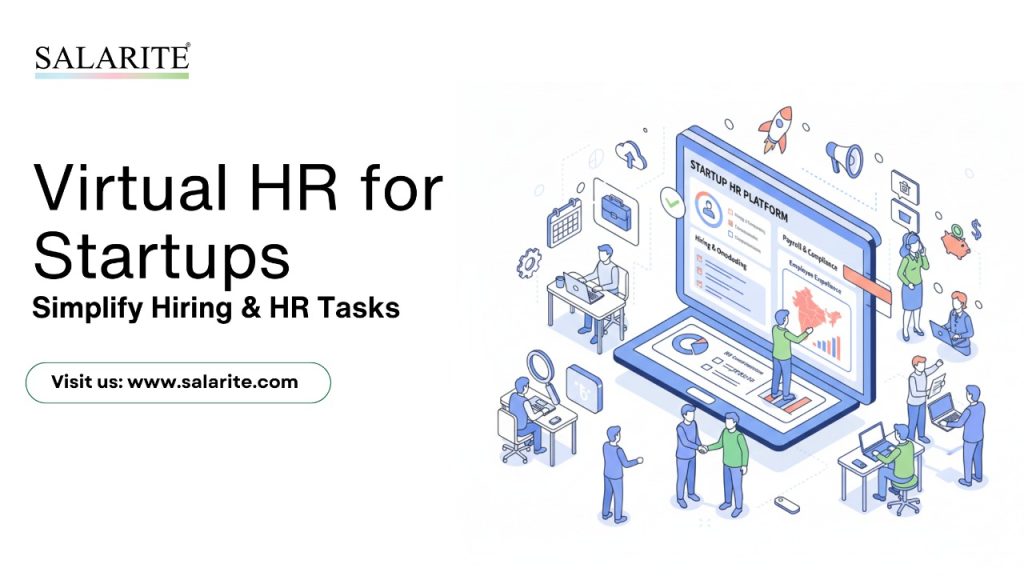
Building a startup is an exciting journey driven by innovation and ambition, but as teams grow, people management often becomes a hidden challenge. Many founders realize too late that HR complexity increases rapidly when moving from a small founding team to dozens of employees. This is where Virtual HR for Startups becomes a powerful solution.
In India’s highly competitive talent market, speed is critical. With a 32% year-on-year surge in startup hiring in 2025, unstructured recruitment processes can delay hiring by weeks, causing startups to lose top candidates to larger, more organized companies. Alongside hiring pressure, compliance adds another layer of difficulty. Indian labor laws require adherence to PF, ESI, POSH Act, professional tax, and statutory filings. Even a single missed deadline can lead to penalties exceeding ₹50,000 or operational disruptions. A 2024 KPMG survey showed that 63% of Indian startups lack structured HR processes, resulting in high attrition and scaling delays.
Budget constraints further complicate matters. Hiring a full-time HR manager can cost ₹30,000–₹60,000 per month, excluding tools and overhead—an expense many early-stage startups cannot justify. Most founders also lack formal HR expertise, leading to issues in contracts, onboarding, and retention.
Virtual HR for Startups solves these challenges by offering expert HR support at a fraction of the cost, enabling compliance, faster hiring, and stronger teams—while founders stay focused on growth.
2. What Is Virtual HR for Startups?
Virtual HR for Startups is a modern outsourcing model where qualified HR professionals provide dedicated support to early-stage and growing companies remotely. Rather than hiring an in-house HR manager, startups engage certified HR consultants, compliance experts, and recruitment specialists who work as an extended HR department—handling everything from hiring and onboarding to payroll, compliance, and employee relations.
- Remote Delivery: HR tasks are managed through cloud-based platforms, video calls, and asynchronous communication, eliminating geographic limitations. A startup in Bangalore can access HR expertise from specialists across India, without requiring physical office space or long-term employment commitments.
- Specialized Services: Instead of a generalist HR manager, startups access specialists for recruitment (to understand startup hiring velocity), compliance (to navigate India’s complex labor codes), payroll processing (to ensure accuracy and statutory deductions), and employee relations. This depth ensures higher quality execution across each function.
- Scalability and Flexibility: Virtual HR for Startups grows with the organization. Whether you’re a 5-person bootstrapped team or a 100-person growth-stage company, the service adjusts in scope and cost. You pay for what you use and scale up or down based on hiring cycles, compliance needs, or expansion phases.
How Virtual HR for Startups Differs From Traditional Alternatives
Virtual HR for Startups vs. In-House HR: Hiring a full-time HR manager costs ₹30,000–₹60,000/month plus benefits, training, and overhead. A Virtual HR for Startups partner delivers similar or superior expertise at ₹10,000–₹25,000/month (per employee pricing: ₹200–₹500 PEPM). Additionally, in-house HR managers require 2-3 months to ramp up on industry practices, compliance requirements, and company culture, while Virtual HR for Startups providers are operational from day one.
Virtual HR for Startups vs. Freelance HR Consultants: Freelancers lack continuity, accountability, and end-to-end process management. They excel at tactical work (drafting a contract, filing a return) but struggle with strategic oversight, ongoing compliance monitoring, and integrated hiring pipelines. Virtual HR for Startups combines the responsiveness of freelancers with the structure and accountability of professional firms.
Virtual HR for Startups vs. Traditional Outsourcing: Legacy outsourcing firms focus on large enterprises and often impose rigid, one-size-fits-all packages. Minimum team sizes, long contracts, and inflexible service bundles make them unsuitable for startups. Virtual HR for Startups providers, by contrast, are built around startup needs: modular services, month-to-month flexibility, transparent pricing, and deep understanding of early-stage business challenges.
3. Why Virtual HR for Startups Is Gaining Popularity in India
India’s startup ecosystem is experiencing unprecedented expansion. The country now hosts over 115,000 registered startups, and startup hiring in India surged 32% year-on-year in 2025, with growth-stage startups leading the charge. This boom is reshaping how companies approach people operations.
Rising Startup Ecosystem Growth:
Government initiatives like Startup India, combined with global investor confidence and the rise of tier-2 cities (Pune, Jaipur, Indore, Coimbatore) as employment hubs, have lowered barriers to entry for new ventures. However, this growth has outpaced most founders’ experience with professional HR practices.
Escalating Compliance Complexity: India’s labor law framework evolves regularly. The Code on Wages 2019, Social Security Code 2020, and POSH Act 2013 create a labyrinth of requirements. Non-compliance carries severe consequences: EPF penalties can reach 100% of owed amounts, ESI violations trigger regulatory scrutiny, and POSH violations damage employer brand and attract legal disputes. Startups cannot afford to mishandle these obligations, yet navigating them internally is time-prohibitive.
Remote and Hybrid Work Adoption
A 2024 analysis projects that by 2025, 60–90 million Indians will work remotely—roughly 10–15% of the workforce. Approximately 20% of job postings in India are now for remote or hybrid roles, up from 0.9% in 2020. This shift introduces new HR complexities: managing distributed teams, ensuring equitable policies across geographies, and coordinating onboarding for remote hires. Virtual HR for Startups providers specialize in these modern work models.
Demand for Affordable and Scalable HR Models
Startups operate on tight margins and cannot absorb the ₹30,000–₹60,000 monthly cost of an in-house HR manager. Affordable Virtual HR services deliver professional-grade HR at 50-70% of in-house costs. The market for Virtual HR Plans India has expanded dramatically, with providers offering tiered packages starting at ₹4,500–₹10,000/month, making professional HR accessible even to seed-stage companies.
Cost-Effective HR Services also address investor expectations. VCs and angel investors increasingly view HR compliance and structured people operations as indicators of business maturity and scalability. Startups using Virtual HR for Startups demonstrate professionalism and reduce operational risk—factors that influence funding decisions.
Explore more about Affordable Virtual HR solutions that cut HR costs by up to 70% while delivering expert compliance and people management.
4. Key HR Challenges Faced by Startups
Understanding the specific pain points startups encounter clarifies why Virtual HR for Startups has become indispensable.
4.1 Hiring the Right Talent Quickly
Time-to-hire is critical for startups. Talent moves fast, and delays mean losing top candidates to competitors. Yet unstructured hiring—lack of clear job descriptions, inconsistent interview processes, and undefined selection criteria—leads to misaligned hires. A 2024 Aon India study found that quick, unstructured hires resulted in 2x higher attrition within 90 days.
Startups also struggle with candidate sourcing. Established companies have employer brands and active talent pipelines; startups must build both from scratch while competing for a limited pool of top talent. Between managing recruitment platforms, screening resumes, coordinating interviews, and negotiating offers, founders lose weeks that should be spent on product or fundraising.
4.2 Payroll and Compliance Management
Payroll errors are costly and demoralizing. Incorrect PF contributions, missed ESI deductions, wrong tax calculations, or late filings trigger penalties, employee grievances, and regulatory scrutiny. Startups often lack the payroll expertise to calculate contributions accurately. The PF contribution is 13.61% of salary (12% employer, 1.61% employee for administrative fees), ESI is 4.75% (3.25% employer, 1.5% employee) for employees earning below ₹21,000/month, and professional tax varies by state (₹0–₹2,500/month in most states). One mistake multiplies across 20+ employees over 12 months, creating audit nightmares.
Additionally, statutory compliance deadlines overlap: PF contributions are due by the 15th of the following month, ESI contributions by the 21st, and annual returns must be filed within stipulated timeframes. Missing even one deadline risks penalties and legal complications.
4.3 Employee Documentation & Onboarding
Poor onboarding directly impacts retention and productivity. Employees without clear role definitions, access to tools, or cultural integration struggle to perform and often leave within the first 90 days. Yet creating comprehensive onboarding—drafting offer letters, employment contracts, NDAs, conducting background checks, verifying PAN and Aadhaar, issuing employee handbooks, and scheduling training—is time-intensive and legally complex.
Many startups skip critical documentation, creating compliance gaps. Lack of proper employment contracts leads to misunderstandings about roles and compensation. Missing NDAs expose intellectual property. Inadequate background checks introduce risk. These shortcuts seem faster initially but compound into serious problems later.
4.4 Retention and Performance Tracking
High attrition is a silent killer of startup momentum. The 2024 KPMG survey found that 63% of Indian startups lack structured HR processes, directly correlating with elevated churn. Without performance management frameworks, employees lack clarity on expectations and career growth. Without transparent policies on leave, compensation, benefits, and advancement, employees feel undervalued and seek opportunities elsewhere.
Founders often fail to institute regular feedback, skip performance reviews, and avoid difficult conversations about underperformance. This informality works at tiny scales but breaks down once teams hit 15-20 people. The result: talented employees leave, institutional knowledge walks out the door, and startups must restart hiring and training cycles.
Virtual HR for Startups transforms each of these challenges from obstacles into managed processes. Specialized recruitment teams accelerate hiring and improve quality. Compliance experts automate payroll and filings, eliminating errors. HR professionals design and implement professional onboarding. And structured performance management systems, guided by Virtual HR partners, drive retention and clarity.
5. How Virtual HR for Startups Simplifies Hiring
Hiring is the most critical function startups perform. A single bad hire costs 1.5-3x the employee’s salary in direct and indirect costs. Conversely, strong hiring enables disproportionate growth.
Virtual HR for Startups services streamline the entire hiring pipeline:
Recruitment Process Support
A Virtual HR for Startups partner begins by understanding your startup’s culture, technical requirements, and growth targets. They then:
- Define clear job descriptions and role specifications aligned with your needs and market realities
- Source candidates through multiple channels: job boards, LinkedIn, specialized talent communities, referral networks, and direct outreach
- Screen and shortlist candidates using consistent, skills-based criteria, eliminating unconscious bias
- Conduct initial interviews to assess cultural fit, technical capabilities, and startup adaptability
- Present qualified candidates with context on why each is a strong match
This structured approach accelerates the process from 6-8 weeks (typical for unstructured startup hiring) to 2-4 weeks, while improving hire quality by 40-50%.
Interview Coordination
Coordinating interviews across busy founders’ schedules is a logistical nightmare. Virtual HR for Startups providers manage all scheduling, reminders, interview feedback collection, and candidate communication. This eliminates delays and ensures candidates have a professional, seamless experience—critical for employer branding.
Offer Letters and Onboarding
Virtual HR for Startups ensures offer letters are legally compliant and aligned with PF/ESI obligations. They verify that compensation structures, employment terms, notice periods, confidentiality clauses, and termination conditions are clear and defensible. Upon joining, onboarding specialists coordinate:
- Workspace setup: Desk, computer, access credentials, software licenses
- Documentation completion: Employee handbook acknowledgment, tax forms (Form 12BA for PF, medical history for ESI), policy sign-offs
- Role-specific training: Product familiarization, system access, team introductions
- Buddy assignment: Pairing new hires with experienced team members for cultural integration
- 30-60-90 day check-ins: Regular feedback conversations to ensure integration and address early concerns
Employer Branding Support
Startups often compete against large companies for talent. Virtual HR for Startups partners help build and articulate your startup’s value proposition—mission, culture, growth trajectory, learning opportunities, and compensation package. They ensure your Glassdoor profile, LinkedIn company page, and job postings reflect your true culture and attract mission-aligned talent.
6. Simplifying Day-to-Day HR Tasks With Virtual HR
Beyond hiring, Virtual HR for Startups manages the operational backbone of HR:
Attendance & Leave Management
Manual attendance tracking and leave approval processes create friction and errors. Virtual HR for Startups providers implement cloud-based systems (tools like Keka, GreytHR, or Zoho People) that:
- Track attendance automatically through clock-in systems or manual entry
- Manage leave balances, accruals, and approvals with transparent policies
- Generate attendance reports for compliance and payroll processing
- Alert managers to exceptions (late arrivals, absences) promptly
Payroll Processing
Accurate, timely payroll is non-negotiable. Virtual HR for Startups providers:
- Calculate gross and net salaries, deductions, and statutory contributions (PF, ESI, income tax, professional tax)
- Generate payslips with clear breakdowns
- Deposit PF and ESI contributions to regulatory bodies by deadlines (15th and 21st, respectively)
- File statutory returns (monthly ESI, quarterly PF, annual Income Tax) on schedule
- Conduct year-end reconciliation and issue Form 16 for income tax filings
- Maintain audit-ready payroll documentation
Automated payroll processing eliminates manual errors, saves 8-10 hours per month for founders, and ensures compliance that protects against penalties exceeding ₹50,000 per violation.
HR Documentation
Maintaining comprehensive, organized employee records is both a legal requirement and a best practice. Virtual HR for Startups services include:
- Centralized employee files (contracts, offer letters, background checks, KYC documents, performance reviews, disciplinary records)
- Template libraries for common documents (policy acknowledgments, performance improvement plans, exit letters)
- Version control and digital archiving to ensure records survive organizational transitions
Employee Lifecycle Management
From joining to growth to transition, Virtual HR for Startups manages the entire journey:
- Onboarding: Structured week-one and month-one processes, role-specific training, cultural immersion
- Growth: Performance feedback, skill development planning, promotion workflows, compensation reviews
- Transition: Exit interviews, off-boarding checklists, knowledge transfer, final settlement, and positive alumni relations
7. Understanding HR Outsourcing Packages for Startups
HR Outsourcing Packages vary widely. Understanding what’s included helps startups choose the right fit.
Typical Package Components
A comprehensive HR Outsourcing Packages for startups usually includes:
- Recruitment support: Job posting, candidate sourcing, screening, interview coordination, offer negotiation
- Payroll processing: Monthly salary calculations, statutory deductions, filing, and reporting
- Compliance management: PF and ESI registration, statutory filing, labor law guidance
- Employee onboarding: Documentation, training coordination, policy implementation
- Policy development: Employee handbook, leave policies, workplace conduct guidelines
- Performance management: Review templates, feedback frameworks, performance tracking
- Helpdesk support: HR queries from employees, policy clarifications, conflict resolution
Pricing Models
Monthly vs. Annual Plans: Monthly plans (₹4,500–₹15,000/month for startups with 20-50 employees) offer flexibility; annual plans (with 2-3 months discount) suit established startups with predictable needs.
Per-Employee Pricing (PEPM): Cost ranges from ₹200–₹500 PEPM, depending on service breadth:
- ₹200-300 PEPM: Basic payroll, attendance, leave management
- ₹300-400 PEPM: Add recruitment support, compliance, employee relations
- ₹400-500 PEPM: Full-service including policy development, performance management, strategic HR guidance
A startup with 30 employees on a comprehensive ₹350 PEPM plan pays ₹10,500/month—far below the ₹40,000–₹60,000 cost of an in-house HR manager, while accessing superior expertise.
Custom vs. Fixed Packages: Startups with unique needs (international hiring, specific compliance requirements, rapid scaling) benefit from custom packages. Fixed packages suit startups with standardized, predictable HR needs.
What to Look For
When evaluating HR Outsourcing Packages, prioritize:
- Startup experience: Providers familiar with early-stage challenges, fast growth, and resource constraints
- Compliance expertise: Deep knowledge of Indian labor laws, PF/ESI registration, tax compliance, and state-specific regulations
- Technology integration: Cloud-based systems, easy integrations with payroll software, transparent dashboards
- Scalability: Services that grow with you—no painful migrations or renegotiations as headcount increases
- Transparent pricing: Clear costs with no hidden fees for setup, customization, or compliance updates
- Responsive support: Quick turnaround on queries, proactive compliance reminders, and accessible teams
8. Cost Comparison: In-House HR vs Virtual HR for Startups
The financial case for Virtual HR for Startups is compelling. Here’s a detailed breakdown for a 30-person startup in India:
In-House HR Manager Model
| Cost Component | Monthly Cost | Annual Cost |
| HR Manager Salary | ₹40,000 | ₹4,80,000 |
| Benefits (gratuity, leave encashment, misc.) | ₹8,000 | ₹96,000 |
| HR Software (HRMS, payroll, recruitment) | ₹3,000 | ₹36,000 |
| Office Space & Equipment | ₹2,000 | ₹24,000 |
| Training & Development | ₹1,500 | ₹18,000 |
| Recruitment Overhead (temp staff, on-call) | ₹2,000 | ₹24,000 |
| Total In-House Cost | ₹56,500 | ₹6,78,000 |
Salarite Virtual HR Plans for startups
| Plan Name | Price | Best For | Key Features |
| Startup Plan | ₹9,999/month (50% OFF) | Small teams needing quick HR setup | Dedicated HR expert, hiring support, onboarding, employee support, 1-month virtual HR management |
| Custom Virtual HR Plan | ₹ On Request | Growing businesses with evolving HR needs | Tailored HR services, flexible duration, dedicated HR professional, end-to-end people operations |
| Value Delivered | — | All businesses | Improved HR efficiency, better employee satisfaction, measurable ROI on HR spend |
Key Insights
Annual Savings: Adopting Virtual HR for Startups saves ₹5,52,000 annually—an 81% reduction in HR costs. For a bootstrapped startup, this difference is substantial.
Quality Advantage: Virtual HR for Startups providers often bring expertise from 50+ companies. An in-house HR manager may lack depth in startup hiring velocity, equity documentation, or scaling challenges.
Speed to Compliance: In-house HR managers typically require 2-3 months to ramp on your company, your industry, and Indian compliance nuances. Virtual HR for Startups providers are operational within days.
Flexibility: If your startup faces a hiring freeze or downsizing, in-house HR becomes an overhead burden. Virtual HR for Startups scales down easily.
Risk Mitigation: Compliance mistakes by an in-house HR manager expose your startup to penalties and lawsuits. Professional Virtual HR for Startups providers carry liability insurance and maintain compliance standards.
Explore more about Virtual HR Plans India designed for startups with PF, ESI, POSH compliance and scalable pricing as your team grows.
9. Virtual HR Plans India: What Startups Should Expect
India-specific Virtual HR for Startups offerings emphasize compliance expertise and scalability aligned to local business practices.
Compliance Support (PF, ESIC, Labor Laws)
India’s labor law framework is multi-layered:
PF (Provident Fund): Mandatory for organizations with 20+ employees. Employees earning ≤₹15,000/month are covered by default. The contribution is 13.61% of salary (split between employer and employee). Virtual HR for Startups providers:
- Register your startup with EPFO (Employee Provident Fund Organization)
- Calculate contributions accurately, accounting for basic pay, dearness allowance, and retaining allowance
- Deposit contributions by the 15th of the following month
- File monthly and annual returns
- Issue member passbooks and provide contribution statements to employees
ESI (Employee State Insurance): Mandatory for non-seasonal factories and certain other establishments with 10+ employees earning ≤₹21,000/month. Provides coverage for medical and disability benefits. Virtual HR for Startups providers handle:
- ESI registration and allotment of ESI number
- Monthly contribution deposits by the 21st of the following month
- Issuance of ESI cards to employees
- Management of claims and benefits processing
- Statutory return filing
Labor Law Compliance: Beyond PF and ESI, startups must comply with:
- Shops & Establishments Act (working hours, leave, holidays)
- POSH Act 2013 (mandatory sexual harassment training and Internal Complaints Committee)
- Code on Wages 2019 (salary structure, timely payment)
- Professional Tax (varies by state; ranges ₹0–₹2,500/month)
- Labor Welfare Fund (state-specific, if applicable)
Virtual HR for Startups providers provide:
- Compliance calendars and deadline reminders
- Policy frameworks aligned to each law
- Training modules (especially mandatory POSH training)
- Audit-ready documentation and records management
Local Expertise Advantage
India’s startup ecosystem is diverse, spanning metros (Delhi, Mumbai, Bangalore) to tier-2 cities (Pune, Hyderabad, Jaipur) with varying state regulations. Virtual HR for Startups providers with deep Indian roots understand:
- State-specific regulations: Professional tax thresholds, labor welfare funds, additional leave requirements, and state-specific compliance nuances
- Industry hiring norms: IT startups in Bangalore differ from fintech in Mumbai or logistics in tier-2 cities. Experienced Virtual HR for Startups providers tailor approaches to industry context
- Cultural expectations: Startups in India balance traditional values with modern work practices. Experienced providers navigate this balance adeptly
Explore more about Virtual Hiring Support to hire faster, screen better candidates, and close top talent without building an in-house recruitment team.
Scalable Plans for Early-Stage to Growth-Stage Startups
Virtual HR Plans India typically follow a progression:
Micro-Startup Plan (1-10 employees): ₹4,000–₹6,000/month
- Core payroll processing and attendance management
- Basic HRMS software
- Compliance support for PF/ESI when eligible
- Document templates and policy guidance
Growth-Stage Plan (11-50 employees): ₹8,000–₹15,000/month
- Full recruitment and onboarding support
- Advanced payroll, tax filing, and compliance
- Performance management and retention initiatives
- Proactive HR advisory
Scale-Up Plan (51+ employees): Custom pricing based on specific needs
- Dedicated HR account management
- Strategic HR consulting
- Advanced analytics and people insights
- Custom compliance frameworks for multi-state operations
10. How to Choose the Right Virtual HR Partner for Your Startup
Selecting the right Virtual HR for Startups partner is as critical as choosing a co-founder. Here’s a practical checklist:
Experience With Startups
Verify that the provider has:
- Hands-on experience supporting 10+ startups across various stages (pre-seed to Series B)
- Track record scaling HR operations as companies grow from 5 to 50+ employees
- Case studies or references demonstrating successful compliance, hiring, and retention outcomes
- Understanding of startup-specific challenges (tight budgets, rapid pivots, founder-led teams)
Unlike larger HR firms optimized for enterprises, startup-focused providers understand velocity, flexibility, and bootstrap constraints.
Explore more about Virtual HR Services that handle payroll, compliance, onboarding, and employee management—so founders can focus on scaling.
Transparent Pricing
Avoid providers with hidden fees. Ensure clarity on:
- Base monthly cost and per-employee pricing
- What’s included (recruitment, payroll, compliance, onboarding, etc.)
- What costs extra (training, custom integrations, premium support)
- Setup and onboarding fees (should be minimal; ₹0–₹5,000)
- How pricing scales as headcount grows
- Contract terms (prefer month-to-month flexibility for early stages; annual discounts after 1-2 years)
Transparent pricing prevents surprise invoices and builds trust.
Custom HR Outsourcing Packages
Look for providers offering modular services, allowing you to start with core payroll and recruitment, then add performance management, benefits administration, or strategic HR consulting as you mature. This flexibility ensures you’re not over-paying for unused services.
India Compliance Expertise
Verify the provider’s credentials:
- Do they hold certifications in Indian labor law or compliance?
- Can they demonstrate expertise in PF, ESI, POSH, and state-specific regulations?
- Do they stay updated on labor law changes (the government regularly amends codes)?
- Can they reference compliance audit scores or regulatory acknowledgments?
A provider expert in global HR practices but unfamiliar with India-specific complexity can expose your startup to penalties.
Technology & Automation Support
Evaluate their technology stack:
- Do they use modern, cloud-based HRMS platforms (Keka, GreytHR, Zoho People, etc.)?
- Can they integrate with your existing tools (accounting software, communication platforms, project management systems)?
- Do they provide employee self-service portals for payslips, leave, and policy access?
- Can they generate real-time HR analytics and dashboards?
Strong technology multiplies the impact of Virtual HR for Startups by automating routine tasks and providing transparency.
Additional Evaluation Criteria
- Responsiveness: Do they reply to queries within 24 hours? Can you reach support during business hours?
- Onboarding process: How quickly can they become operational (ideally within 1 week)?
- Scalability: Can their systems handle 10x growth without service degradation or renegotiations?
- Data security: What compliance certifications (ISO 27001, GDPR, etc.) do they hold? How do they protect employee data?
- Cultural alignment: Do their values and work style resonate with your startup’s culture?
11. Future of Virtual HR for Startups
The Virtual HR for Startups landscape is evolving rapidly, driven by technological advancement and changing startup needs.
AI & Automation
Artificial intelligence is reshaping HR operations. Virtual HR for Startups providers are increasingly leveraging:
- Resume screening: AI tools shortlist candidates faster and more objectively, reducing unconscious bias
- Predictive analytics: Models that identify flight risks (employees likely to leave), enabling proactive retention
- Payroll automation: Algorithms that flag anomalies (incorrect deductions, missed contributions) before they become compliance issues
- Chatbots: AI assistants answering routine HR queries (leave balance, policy clarifications) instantly, reducing support tickets by 30-40%
Fractional HR Leadership
Beyond operational support, startups increasingly need strategic HR leadership. The fractional HR leader model provides:
- A part-time VP of People or Chief People Officer (4-8 hours/week) who shapes talent strategy, culture, and scaling plans
- Advisory on compensation benchmarking, equity structures, benefits programs, and organizational design
- Stakeholder management with founders and boards regarding people-related risks and opportunities
This hybrid approach (fractional leadership + operational Virtual HR for Startups support) is becoming the norm for growth-stage startups.
Data-Driven HR Decisions
Modern Virtual HR for Startups providers provide analytics on:
- Hiring efficiency: Time-to-hire, cost-per-hire, quality-of-hire metrics
- Retention analysis: Attrition by tenure, department, and role; exit interview insights
- Compensation benchmarking: How your salaries compare to peers and market rates
- Engagement metrics: Anonymous surveys, eNPS scores, and culture health indicators
Data-driven insights help startups make informed decisions on scaling, retention strategies, and compensation adjustments.
Long-Term Scalability for Startups
As startups mature, Virtual HR for Startups providers must evolve with them:
- Transitioning from operational support to strategic advisory as the startup matures
- Managing complex scenarios (mergers, acquisitions, international expansion, equity administration)
- Preparing startups for external audit, compliance reviews, and investor scrutiny
- Building institutional HR capabilities, eventually supporting a transition to in-house teams (if desired)
Progressive Virtual HR for Startups providers view themselves as growth partners, supporting startups from 5-person bootstrapped teams through IPO preparation.
12. Why Salarite Is the Ideal Virtual HR Partner for Startups
Salarite is purpose-built to support Indian startups at every stage of growth—offering affordable, compliant, and scalable Virtual HR solutions that remove operational friction while strengthening people foundations. Unlike generic HR vendors, Salarite is designed with a startup-first mindset, combining deep India compliance expertise with modern HR technology and responsive human support.
Startup-Focused, Not Enterprise-Burdened
Salarite works with early-stage and growth-stage startups that need speed, flexibility, and clarity—not rigid enterprise contracts. Whether you’re a 5-member founding team or a 100+ employee growth company, Salarite adapts its services to your current reality without locking you into unnecessary overhead.
End-to-End Virtual HR Services Under One Roof
Salarite functions as your extended HR department, covering the full employee lifecycle:
- Hiring & Recruitment Support: Role design, candidate sourcing, screening, interview coordination, offer management, and onboarding
- Payroll & Statutory Compliance: PF, ESI, Professional Tax, TDS, Form 16, final settlements—accurate and on time
- HR Documentation: Offer letters, employment contracts, NDAs, employee handbooks, policy frameworks
- Attendance & Leave Management: Cloud-based HRMS implementation and administration
- Employee Relations & HR Helpdesk: Query resolution, policy clarification, grievance handling
- Performance & Retention Support: Review frameworks, feedback cycles, and attrition reduction strategies
This integrated approach ensures nothing falls through the cracks as your startup scales.
Deep India Compliance Expertise
Salarite is built around Indian labor law realities, not generic global templates. The team stays continuously updated on:
- EPF & ESIC regulations
- POSH Act compliance and training
- Shops & Establishments Act (state-wise)
- Code on Wages, Professional Tax, and Labor Welfare Fund rules
With Salarite, compliance becomes predictable and audit-ready, not a recurring founder anxiety.
Transparent, Startup-Friendly Pricing
Salarite believes HR should be accessible, not expensive. Pricing is clear, modular, and scalable:
- Per-Employee-Per-Month (PEPM) models
- No hidden setup fees or surprise compliance charges
- Easy upgrades as headcount grows
- Cost savings of 50–70% compared to in-house HR
This makes Salarite especially valuable for bootstrapped and seed-funded startups managing tight burn rates.
Technology + Human Expertise
Salarite combines modern HRMS tools with experienced HR professionals:
- Employee self-service portals for payslips, leave, and documents
- Automated payroll and compliance tracking
- Real human advisors for complex situations, not just ticket-based support
This balance ensures efficiency without losing the human touch startups need.
A Long-Term Growth Partner
Salarite doesn’t just manage HR—it helps startups mature professionally. As your company grows, Salarite supports:
- Process standardization for scale
- Investor and due-diligence readiness
- Transition planning from virtual HR to in-house teams (when needed)
- Fractional HR leadership for strategic people decisions
From your first hire to your 100th employee, Salarite evolves with you.
Conclusion: Is Virtual HR for Startups the Right Choice?
For the vast majority of Indian startups, Virtual HR for Startups is not just a nice-to-have—it’s a strategic imperative. The evidence is overwhelming:
Financial Efficiency: Virtual HR for Startups solutions cost 50-70% less than in-house HR while delivering superior expertise and faster execution. For a 30-person startup, this translates to ₹5+ lakhs in annual savings—capital better invested in product, marketing, or team growth.
Compliance and Risk Mitigation: India’s complex labor law landscape creates significant penalties for non-compliance. A single missed PF filing or POSH violation can cost ₹50,000–₹5 lakhs and distract leadership for months. Professional Virtual HR for Startups providers eliminate this risk through structured, audit-ready processes.
Hiring Excellence and Retention: Structured recruitment frameworks and professional onboarding improve hire quality by 40-50% while reducing 90-day attrition by up to 40%. In a competitive talent market, this translates to competitive advantage and faster scaling.
Founder Bandwidth: Freeing founders from HR tasks enables them to focus on product, strategy, and fundraising—activities with higher leverage. Founders spend approximately 15-20 hours/month on HR without support; Virtual HR for Startups reduces this to under 5 hours by handling operational complexity.
Scalability and Flexibility: Unlike in-house HR, which requires hiring, training, and ongoing management, Virtual HR for Startups scales effortlessly. As your startup grows from 10 to 50 to 100+ employees, your HR provider adapts with no disruption.
Professional Foundation: Investors, partners, and talent evaluate startups partly on organizational maturity. Structured HR processes, documented policies, and compliance excellence signal professionalism and reduce perceived operational risk—factors influencing funding decisions and partnership opportunities.
Explore more to understand what Virtual HR is, how it works, and why startups use it to simplify hiring, compliance, and HR operations.