

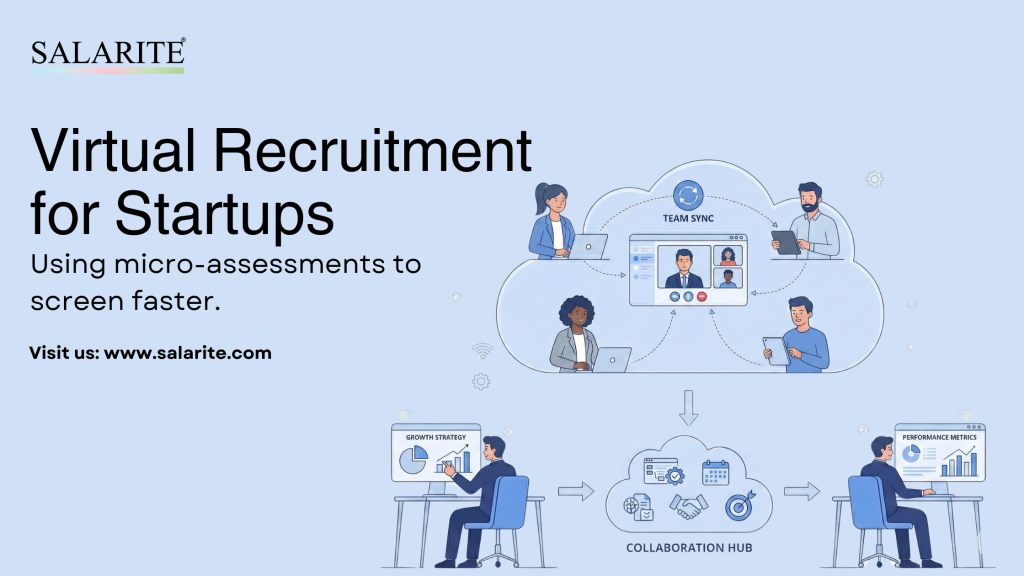
Hiring for a startup has never been easy — the pace is fast, resource limitations are real, and talent expectations are rising. In 2025–26, startups are competing fiercely not only with each other but with MSMEs and global remote-first companies. This has made Virtual Recruitment for Startups one of the most important competitive differentiators in the modern hiring landscape.Long hiring processes are not something that startups can afford. They require swift applicants, precise shortlisting, dependable assessment and time saving, energy saving and decision illuminating recruitment mechanisms.
Platforms like Salarite are restructuring talent discovery to young companies with help of micro-assessment, automation by AI and virtualized hiring support. The distance work has been increased, Remote Recruitment India has been initiated and legal and HR structures are becoming complicated. These forces are driving startups to use systematic tools, automated processes, and uniform HR-policy-writing.
1. Understanding Virtual Recruitment for Startups.
Virtual Recruitment for Startups Start ups Virtual Recruitment is a completely online solution which allows young companies to recruit and screen talent without meeting them face-to-face. They rely on online resources, micro-tests, automation, and AI-powered processes to identify the most suitable candidates in the shortest time possible without using long face-to-face interviews or paper-and-pencil tests. The approach is particularly beneficial when dealing with startups which must grow quickly and are required to maintain low expenses. It allows organizations to filter through a larger applicant pool, trade skills with precision, hold virtual interviews and make more confident hiring decisions, without slowing down, losing a flexible and efficient approach in the growth process.
Why Startups Prefer Virtual Recruitment:
1. Faster Decision-Making
Virtual hiring tools allow startups to review applications, assessment results, and shortlisted candidates in real time. Automated scoring and structured evaluation reduce delays in choosing the right candidate. By streamlining communication and feedback, decision-making becomes faster, enabling startups to secure talent before competitors do.
2. Lower Hiring Cost
Digital hiring reduces expenses associated with job fairs, travel, manual paperwork, and in-person interviews. Micro-assessments and automation help startups evaluate more candidates with fewer resources. This cost-efficient approach ensures startups can hire skilled professionals while preserving budgets for growth, product development, and operations.
3. Access to Wider Talent Pools
Virtual Recruitment for Startups removes geographical limitations, allowing startups to source talent from anywhere in India. Whether they need developers, marketers, or analysts, startups can connect with skilled candidates beyond their local city. This broader reach increases the chances of finding high-quality applicants who fit the company’s culture and goals.
4. Higher Automation and Accuracy
Automation in virtual hiring improves screening accuracy by using AI tools, structured tests, and data-driven scoring. Startups can avoid human bias and manual errors while identifying candidates who best match skill and role requirements. This results in consistent, reliable hiring decisions for long-term team success.
5. Consistent Evaluation Workflows
Virtual recruitment systems ensure every candidate goes through the same screening steps, assessments, and evaluation criteria. This consistency improves fairness, transparency, and efficiency. Startups benefit from standardized workflows that simplify comparison, reduce hiring gaps, and support seamless collaboration between hiring managers and HR teams.
What makes Virtual Recruitment for Startups transformative is not just the shift online but the integration of micro-assessments, AI-driven candidate scoring, and automated communication workflows. Startups now value hands-on indicators over paper resumes — real skills, real problem-solving, real culture fit. This combination of speed and depth is exactly why virtual hiring has become the go-to model for startups between 2025–26.
Explore More: Redefine your recruitment with Virtual Hiring Support. Discover how AI-powered screening and smart scheduling can help you hire faster, smarter, and more efficiently in 2025.
2. Why Micro-Assessments Are the Future of Startup Hiring?
Micro-assessments are becoming indispensable in the present-day working world of the Virtual Recruitment for Startups in a fast-moving environment. They allow founders to screen candidates in a short time span in a precise and high-volume fashion, rather than by lengthy interviews or subjective opinions. Micro-tests are used to assess actual skills using small focused tasks. The strategy allows startups to identify high-performing applicants early in the funnel, reducing the hiring time and improving quality. They remove the element of guessing since they offer solid and evidence-based information on problem solving, communication, technical know-how and flexibility. With the growing popularity of remote and digital hiring, micro-assessment is an opportunity to enable startups to make more intelligent, quicker, and sure hiring choices.
- take under 5–10 minutes
- test real-world job skills
- reveal how candidates behave under pressure
- provide measurable insights to hiring teams
Startups benefit because:
- candidates can be screened in bulk
- irrelevant profiles are filtered out early
- the top 10–20% of candidates rise instantly
- interviewers focus only on real contenders
With platforms like Salarite integrating micro-assessments into their Virtual Hiring Support, startups can objectively evaluate talent long before scheduling interviews — saving days of effort.
3. How Micro-Assessments Improve Precision in Virtual Recruitment?
Micro-assessment is a short, specific exam that can determine the actual competence of the candidate, not through the use of lengthy interviews or generalized resumes. They make founders identify those who can carry out the job-specific tasks at a fast pace in virtual recruitment of startups. Such evaluations reduce guessing by providing role-specific and objective information within a few minutes. Virtual Recruitment for Startups have the opportunity to assess communication, problem-solving, and technical abilities or job situation and only qualified candidates can be promoted. This method will minimize errors in hiring, accelerate short listing and enhance role fit- with start ups more likely to recruit strong teams more precisely and efficiently.
Unlike traditional tests, micro-assessments provide:
Micro-assessments offer faster, role-specific evaluations that fit perfectly into Virtual Recruitment for Startups. Instead of lengthy exams, they measure real skills through short, targeted tasks. This helps startups screen candidates accurately, reduce drop-offs, and identify job-ready talent within minutes.
- Skill-specific clarity: In Virtual Recruitment for Startups, micro-assessments help recruiters evaluate candidates on exact skills rather than broad assumptions. By testing real, job-relevant abilities, startups can quickly determine whether applicants meet technical, analytical, or communication standards. This level of precision reduces mis-hires and ensures only capable candidates progress in the hiring funnel.
- Faster processing times: Micro-assessments speed up Virtual Recruitment for Startups by delivering instant, automated results. Instead of waiting for long interview rounds, startups receive quick performance insights that support faster shortlisting. This accelerated process allows lean teams to hire efficiently while keeping top candidates engaged, reducing dropout rates and overall hiring time.
- Higher engagement and completion rates: Short, interactive assessments used in Virtual Recruitment for Startups increase candidate participation by reducing fatigue and making evaluations more user-friendly. Because micro-assessments take only a few minutes, candidates complete them at a much higher rate. This leads to stronger applicant pools and more accurate comparisons between multiple candidates.
- Accurate performance benchmarks: Micro-assessments create reliable benchmarks in Virtual Recruitment for Startups by measuring skills against standardized evaluation criteria. Startups can easily compare results across candidates and roles, ensuring fairer and more consistent hiring decisions. These benchmarks also help employers identify top performers early and align them with job expectations.
- Bias-free scoring using AI: AI-driven scoring ensures Virtual Recruitment for Startups remains objective and unbiased. Micro-assessments eliminate human subjectivity by evaluating only measurable performance indicators. This improves fairness, supports diversity, and helps employers focus solely on skill readiness, creating a transparent selection process that benefits both candidates and recruiters.
Startups can customize micro-assessments based on:
Startups using Virtual Recruitment for Startups can design micro-assessments tailored to job roles, required competencies, and real-world tasks. These assessments can focus on technical skills, communication, problem-solving, or behavioral traits, helping teams evaluate candidates precisely and quickly during early screening stages.
Role Level
In Virtual Recruitment for Startups, micro-assessments help evaluate candidates according to the exact seniority a role requires. Whether hiring entry-level talent or mid-level specialists, these assessments confirm readiness and skill depth. This ensures candidates match the expectations of the position, reducing mismatches and onboarding difficulties.
Department
Different departments need different strengths, and Virtual Recruitment for Startups makes this easier by tailoring micro-assessments for tech, operations, sales, HR, and finance roles. Each test measures department-specific abilities, allowing startups to compare candidates fairly and select those who can genuinely perform the job’s core tasks.
Competency Type
Competencies like communication, analytical thinking, teamwork, and leadership can be measured quickly through micro-assessments in Virtual Recruitment for Startups. These short evaluations help identify candidates with the right mindset and soft skills needed for growth-focused environments, reducing reliance on subjective interviews and improving hiring accuracy.
Work Environment
Every startup has a different culture—fast-paced, remote, hybrid, or collaborative. With Virtual Recruitment for Startups, micro-assessments can reveal whether a candidate fits that environment. These tests measure adaptability, time management, and communication style, ensuring candidates can thrive within the startup’s preferred workflow and culture.
Problem-Solving Needs
Startups require candidates who can think fast and solve unexpected challenges. In Virtual Recruitment for Startups, micro-assessments evaluate real-world problem-solving abilities through case tasks, situational scenarios, or logical reasoning tests. This helps startups identify candidates who can handle pressure and contribute meaningful solutions from day one.
Micro-assessments also improve candidate experience by avoiding long, time-consuming hiring routines. This matters because skilled talent often rejects companies with lengthy hiring cycles.
Learn More: Simplify local talent hiring with Candidate Screening in Rajasthan. Explore tools and techniques to identify the right candidates for your business faster than ever.
4. The Rise of Remote Recruitment India.
Remote Recruitment India has transformed how businesses access talent by removing geographical limitations and enabling faster, technology-driven hiring. As more companies shift toward flexible and distributed work models, remote hiring has become a strategic advantage—especially for emerging businesses. Through Virtual Recruitment for Startups, organizations can source candidates nationwide, assess skills digitally, and build agile teams without relocation barriers. This approach reduces hiring costs, widens the talent pool, and ensures access to specialized skill sets. With digital assessments, automated screening, and virtual onboarding becoming standard, Remote Recruitment India is reshaping how modern startups scale efficiently and competitively.
Virtual hiring simplifies:
- Pan-India Candidate Availability: Pan-India candidate availability allows startups to find talent from any state without limiting themselves to local hiring. With Virtual Recruitment for Startups, companies can reach skilled applicants nationwide, increasing diversity, improving match quality, and speeding up the hiring cycle.
- Multi-State Onboarding: Multi-state onboarding makes it easy for startups to welcome new hires from different regions through digital tools, remote orientation, and standardized processes. This ensures smooth integration, consistent communication, and faster productivity for employees joining from anywhere in India.
- Contract Hiring: Contract hiring enables startups to bring in skilled professionals for short-term or project-based roles. This flexible model helps them manage workload shifts, control budgets, and access specialized talent quickly without long-term commitments or complex employee management.
- Performance Monitoring: Performance monitoring in remote settings allows startups to track work quality, productivity, and engagement using digital dashboards and KPIs. This ensures accountability, identifies improvement areas early, and helps managers support employees with timely feedback and guidance.
- Remote Documentation: Remote documentation simplifies how startups collect, verify, and manage employee records online. It eliminates paperwork delays, enhances accuracy, and keeps all essential documents securely stored, making compliance and onboarding faster and easier for distributed teams.
With remote recruitment becoming the norm, Indian startups are scaling their teams without office constraints, salary limitations, or geographical restrictions.
Start Now: Build your dream team with Remote Recruitment in India. Learn how startups can attract remote professionals, save costs, and scale globally with Salarite’s advanced tools.
5. The Role of Virtual Hiring Support in Modern Startup Recruitment.
Virtual Recruitment for Startups is reshaping how young companies hire by bringing speed, structure, and accuracy into the hiring process. Virtual Hiring Support eliminates the delays of traditional recruitment by automating assessments, communication, and scheduling. Startups gain the ability to evaluate candidates through micro-assessments, AI-driven screening, and online interviews—allowing them to shortlist talent in hours instead of weeks. This digital-first approach also improves consistency, reduces bias, and ensures every applicant is assessed fairly. As competition for quality talent grows, Virtual Hiring Support has become essential for startups that need to scale quickly with the right people.
- automated scheduling
- real-time candidate scoring
- micro-assessments
- communication templates
- structured interview frameworks
- actionable analytics
By handling repetitive hiring tasks, Virtual Hiring Support allows founders and small HR teams to focus on decision-making rather than admin work. It also enables error-free coordination, reduces hiring delays, and ensures that all candidates experience a smooth, professional hiring journey.
6. Why Candidate Screening Rajasthan Matters for Local & Regional Hiring?
Candidate Screening Rajasthan plays a crucial role in ensuring that hiring across Jaipur and surrounding regions is accurate, culturally aligned, and skill-focused. Local hiring demands an understanding of regional work habits, communication styles, and job expectations, which traditional screening methods often overlook. With Virtual Recruitment for Startups becoming the norm, region-specific screening brings deeper insight into candidate suitability and reduces mismatches. It also strengthens trust by verifying credentials, local experience, and stability. For startups and MSMEs scaling rapidly, this approach leads to faster, more reliable hiring decisions tailored to Rajasthan’s unique talent ecosystem.
Startups in Rajasthan often face:
- High applicant volumes: Startups often receive hundreds of applications for a single role, making it difficult to sort genuine talent from irrelevant profiles. This slows the hiring cycle and reduces overall recruitment efficiency.
- Limited HR bandwidth: Most startups operate with small HR teams, leaving little time for resume screening, follow-ups, and interview scheduling. This creates delays and increases the risk of missing strong candidates.
- Skilled talent shortages in niche fields: Roles in tech, analytics, and product often face talent gaps. Startups struggle to identify candidates with the exact skill sets needed, making hiring highly competitive and time-consuming.
- Difficulty verifying credentials: Without structured systems, checking candidate experience, certifications, or work history becomes challenging. Inaccurate information can lead to poor hiring decisions and costly onboarding mistakes.
Candidate Screening Rajasthan solves this by offering:
- Pre-verified profiles: Profiles come pre-checked for skills, experience, and basic credibility, helping startups skip early verification steps and move candidates into evaluation stages much faster.
- AI-based background insights: AI analyzes candidate patterns, job history, and behavioral indicators to offer deeper insights, enabling startups to make confident, data-backed hiring decisions instantly.
- Localized assessment frameworks: Region-specific tests and cultural fit evaluations ensure candidates align with local work environments, especially valuable for Rajasthan-based hiring needs.
- Structured shortlisting: Automated filters and scoring models rank candidates by relevance, ensuring only high-fit applicants move forward, reducing manual review time significantly.
Explore More: See how AI is reshaping Candidate Screening Services. Discover tools that speed up hiring, improve candidate accuracy, and make recruitment smarter.
7. How HR Policy Drafting Supports Scalable Virtual Hiring?
Effective HR Policy Drafting is essential for building a hiring system that can grow as a startup expands. In the context of Virtual Recruitment for Startups, well-designed policies create clarity, consistency, and structure across all digital hiring activities. Policies define standardized assessment methods, communication rules, remote interview guidelines, and compliance requirements, ensuring every candidate experiences a fair and efficient process. They also streamline onboarding, role expectations, confidentiality standards, and documentation workflows—reducing confusion for both HR teams and new hires. With strong policies in place, startups can scale virtual hiring confidently, maintaining quality even as recruitment volumes increase.
1. Remote Hiring Guidelines
Clear remote hiring guidelines help startups maintain consistency in interviews, assessments, and communication. With Virtual Recruitment for Startups, these guidelines ensure every candidate undergoes a fair, transparent, and professional selection process, improving hiring speed and overall candidate experience.
2. Virtual Onboarding SOPs
Structured virtual onboarding SOPs allow startups to integrate new employees smoothly into digital teams. Through Virtual Recruitment for Startups, these SOPs create a predictable, supportive workflow that boosts early engagement, clarity, and productivity from day one.
3. Digital Workplace Rules
Strong digital workplace rules set expectations for communication, attendance, collaboration tools, and remote work discipline. In Virtual Recruitment for Startups, these rules help maintain team alignment and ensure new hires adapt quickly to a tech-enabled work environment.
4. Data Privacy & Security Clauses
Data privacy and security clauses protect both the company and candidates during online hiring. As Virtual Recruitment for Startups relies heavily on digital tools, these clauses ensure safe handling of personal information and compliance with modern hiring regulations.
5. Performance Evaluation Methods
Clear performance evaluation methods help startups track progress, measure output, and support employee growth. In Virtual Recruitment for Startups, structured evaluations ensure remote hires are assessed fairly, using measurable results instead of subjective opinions.
6. Grievance Redressal Structures
A transparent grievance redressal structure gives employees confidence that their concerns will be addressed promptly. Within Virtual Recruitment for Startups, this system supports a healthy remote culture and ensures that communication gaps or disputes are resolved efficiently.
8. Comparing Virtual Recruitment vs Traditional Recruitment.
HR Policy Drafting creates clear guidelines for interviews, assessments, communication, and onboarding, ensuring consistency and compliance. With structured processes, Virtual Recruitment for Startups becomes easier to scale, reduces confusion, and improves hiring quality across remote and hybrid teams.
| Feature | Virtual Recruitment for Startups | Traditional Recruitment |
| Speed | Very fast (hours/days) | Slow (weeks) |
| Cost Efficiency | High | Low |
| Talent Reach | Global | Local only |
| Screening Tools | Micro-assessments & AI | Manual screening |
| Scalability | High | Limited |
| Candidate Experience | Strong | Outdated |
| Flexibility | Fully remote | On-site constraints |
Virtual methods consistently outperform traditional hiring in speed, depth, accuracy, and cost-efficiency — especially for startups.
9. Micro-Assessment Types Startups Should Use
Startups can speed up the process of hiring using special micro-assessment, which measures actual skills in a few minutes. These are role-based skill quizzes, problem-solving situations, coding tests, communication tests, and job-simulation tests. Micro-assessments can be used to identify true capability very fast, weed out people who are not fit and only those with high potential can proceed. They are particularly applicable to rapidly increasing teams, which require precise, effective, and unbiased screening.
1. Skill-Based Tests
These tests measure a candidate’s practical abilities in areas like writing, analytics, sales communication, or software tools. They help startups quickly identify who can perform core job tasks without requiring long training cycles.
2. Personality Micro-Assessments
Short personality assessments help startups understand how candidates behave under pressure, solve problems, and collaborate. They are helpful for spotting cultural fit and predicting long-term performance in small, fast-moving teams.
3. Cognitive Abilities Tests
These assessments check logical thinking, memory, reasoning, and problem-solving skills. Startups use them to identify candidates who can adapt quickly, learn fast, and work well in dynamic environments.
4. Role-Play Simulations
Role-plays place candidates in real job scenarios, such as handling a client inquiry or giving feedback. They reveal communication style, confidence, and how effectively someone can respond during real challenges.
5. Case-Study Snippets
Short case studies ask candidates to analyze a situation and provide solutions. Startups use them to evaluate strategic thinking, business understanding, and the ability to interpret information under time pressure.
6. Coding Micro-Tests
For tech roles, quick coding tasks help startups evaluate logic, syntax knowledge, and debugging skills. These assessments show true technical capability without requiring long, complex assignments.
7. Behavioral Scenario Tests
These tests measure how candidates react to workplace situations—conflict, deadlines, teamwork, or ethical dilemmas. They help identify responsibility, decision-making patterns, and emotional intelligence.
Start Exploring: Empower your hiring with Candidate Sourcing Tools for Jaipur Startups. Find innovative ways to discover, assess, and hire skilled professionals locally.
10. How Salarite Powers Virtual Recruitment for Startups?
Startups today grow at a rapid pace, but hiring the right talent quickly—and within budget—remains one of their biggest challenges. Salarite solves this problem by providing a fully digital, scalable, and cost-effective Virtual Recruitment for Startups ecosystem built specifically for emerging businesses. Here’s how Salarite empowers startups to hire smarter and faster:
1. AI-Driven Candidate Matching
Salarite uses intelligent algorithms to match job requirements with the most relevant talent profiles. This eliminates guesswork, shortens the hiring cycle, and boosts the chances of finding high-quality, job-ready candidates.
2. Automated Screening & Assessments
Startups often lack the time to manually review hundreds of resumes. Salarite’s automated tools screen applications for skills, experience, and cultural fit—ensuring only the most suitable candidates move forward.
3. Virtual Interviews & Real-Time Scheduling
Integrated virtual interview tools help founders and HR teams conduct structured discussions without logistical delays. Automated scheduling reduces back-and-forth communication, saving valuable time.
4. Pan-India Talent Access
Salarite opens doors to a nationwide talent pool, enabling startups to hire beyond geographical boundaries. This is especially beneficial for remote-first or hybrid organisations looking for specialized skill sets.
5. Cost-Effective Hiring Operations
With limited budgets, startups must optimise every expense. Salarite’s virtual recruitment model significantly reduces travel, onboarding, and administrative costs while improving operational efficiency.
6. Scalable Support for Growing Teams
As startups expand, hiring demands increase. Salarite’s virtual recruitment framework scales effortlessly—supporting bulk hiring, role expansion, and new team setups.
11. Best Practices for Virtual Recruitment for Startups.
Successful Virtual Recruitment for Startups requires clarity, speed, and structured evaluation. Startups should use micro-assessments for quick skill checks, maintain transparent communication, and centralize all candidate data for easier decision-making. Adopting AI-driven screening, consistent evaluation criteria, and streamlined interview workflows ensures faster, bias-free hiring. These practices help startups build strong teams efficiently in a competitive digital landscape.
1. Keep assessments short
Short assessments help candidates stay engaged and reduce drop-off rates during virtual hiring. By focusing on one or two essential skills, startups can evaluate job readiness quickly without overwhelming applicants. This approach improves screening speed, ensures higher completion rates, and creates a smoother recruitment experience for both candidates and hiring teams.
2. Use role-based tests
Role-based tests allow startups to measure real, job-specific abilities instead of relying only on resumes. By assigning tasks aligned with the actual responsibilities of the position, employers gain clearer insights into candidate capability. This method increases accuracy, reduces mismatched hires, and ensures that only truly qualified applicants move forward.
3. Standardize evaluation criteria
Standardizing your evaluation criteria ensures fairness, consistency, and objectivity during the screening process. When every candidate is measured on the same parameters—skills, communication, problem-solving, and cultural fit—it becomes easier to compare applicants properly. This reduces bias and supports more confident, data-driven hiring decisions that benefit the entire recruitment workflow.
4. Automate repetitive communication
Automating routine communication—such as confirmations, reminders, and follow-up messages—saves startups hours of manual effort. Automated messaging keeps candidates informed, reduces confusion, and ensures no applicant is missed. This also creates a professional, timely, and organized hiring experience that maintains engagement throughout the recruitment process.
5. Use HR Policy Drafting for clarity
Clear policies provide structure to virtual hiring processes, helping teams avoid confusion and misalignment. Through HR Policy Drafting, startups can define assessment rules, communication guidelines, interview formats, and documentation standards. This clarity builds consistency across hiring stages and ensures that every team member follows the same professional and compliant workflow.
6. Maintain a talent pool
Keeping an active talent pool allows startups to hire faster whenever new roles open. By storing profiles of promising candidates who were not selected previously, companies reduce future sourcing time. A strong talent pool also supports continuous hiring, enabling startups to scale efficiently without repeating the entire recruitment cycle each time.
7.Combine manual judgment with AI insights
AI-powered tools provide fast, accurate screening, but human judgment ensures contextual understanding. Combining the two allows recruiters to balance data with intuition. AI handles scoring, sorting, and pattern detection, while humans assess personality, values, and long-term potential—resulting in smarter, well-rounded hiring decisions.
8. Track hiring data
Tracking hiring metrics helps Virtual Recruitment for Startups understand what works and what needs improvement. Data such as completion rates, assessment scores, time-to-hire, and candidate drop-off points offer insights into process strengths and weaknesses. Regular analysis helps refine recruitment strategies, minimize bottlenecks, and improve long-term hiring outcomes.
9. Improve continuously
Continuous improvement is essential for effective virtual recruitment. By regularly reviewing feedback, updating assessments, refining communication, and adjusting strategies based on performance data, startups stay agile and competitive. This ongoing enhancement ensures smoother workflows, better candidate experiences, and stronger hiring results over time.
12. Final Thoughts
Startups do not have to stick to intuition or multiple interview sessions. Virtual Recruitment for Startups hiring with the ability to conduct structured assessments, immediate skill assessments, online background checks, and remote onboarding, which save time and money and expand the talent pool nationwide. It also ensures that there is a fair and standardized selection process which assists the young companies to come up with teams that are not only qualified but also culturally fit.
In Virtual Recruitment, Salarite makes recruiting effortless and future-proof. The site incorporates the innovative sourcing technology, candidate insight, screening services, and connectivity to the current HR systems. Startups are able to have more candidates shortlisted, enhance hiring accuracy and have scalable recruitment pipelines without incurring an operational burden.
Start Now: Experience seamless Applicant Tracking System Integration in India. Learn how connecting your ATS with Salarite can automate workflows and enhance hiring outcomes.
FAQs
Virtual recruitment for startups uses digital tools, online assessments, and automated workflows to hire talent without physical interviews. It helps founders build teams faster, reduce costs, and evaluate candidates efficiently using modern hiring technology designed for speed and accuracy.
Micro-assessments provide quick, skill-focused evaluations that filter candidates based on real ability rather than lengthy tests or resumes. They help startups identify strong performers early, reduce screening time, and maintain consistency in hiring decisions across various job roles.
Virtual Hiring Support streamlines communication, automates shortlisting, schedules interviews, and delivers structured evaluations. It removes manual delays and ensures more accurate hiring decisions, helping startups manage recruitment efficiently even with small HR teams or high application volumes.
Candidate Screening Rajasthan is a regional screening model that verifies skills, assesses cultural alignment, and ensures better suitability for local roles. It strengthens hiring accuracy for companies recruiting in Rajasthan by offering region-specific insights and structured evaluation standards.
Remote Recruitment India enables startups to hire talent from any city, broadening access to diverse skill sets. It removes location barriers, supports flexible work models, and helps companies scale quickly by sourcing specialists across India without relocation challenges.
Yes. Micro-assessments are adaptable and can evaluate technical, creative, analytical, and communication skills. They work effectively for roles in IT, marketing, sales, HR, finance, and operations by focusing on real-world task performance rather than subjective screening.
Salarite provides Online HR Policy Creation, customizable templates, onboarding structures, compliance documents, and role-specific policy formats. These resources help startups maintain clear processes, meet legal requirements, and establish efficient internal systems without needing in-house HR expertise.
Salarite speeds up hiring by automating resume shortlisting, skill assessments, communication, and interview scheduling. Its digital workflows remove manual delays, ensure faster decision-making, and help startups move candidates through each stage with minimal effort and maximum efficiency.
Virtual hiring systems use automated scoring, standardized assessments, and structured workflows to minimize bias and improve accuracy. They create consistent evaluations, verify skills effectively, and help startups hire confidently based on proven data rather than subjective impressions.
Yes. Virtual hiring is now a sustainable, scalable recruitment strategy for modern startups. It supports remote teams, reduces hiring costs, and provides continuous access to nationwide talent. Startups can rely on these systems to build strong teams efficiently.