

Hiring the right people is important for every growing business. However, finding suitable candidates, reviewing applications, and managing interviews can take time. A Recruitment Platform for Companies helps employers manage these tasks in one place. For startups, MSMEs, and large businesses, the right platform depends on their hiring needs. For example, companies hiring for manufacturing, banking, finance, FMCG, and sales roles may need different tools. Therefore, employers should compare platform features, costs, and support before making a choice.
What Is a Recruitment Platform for Companies?
A Recruitment Platform for Companies is an online tool that helps businesses manage their hiring process.
Depending on its features, it may help employers:
- Post job openings.
- Find suitable candidates.
- Review applications.
- Screen candidate profiles.
- Manage interviews.
- Track hiring progress.
As a result, HR teams can keep job and candidate details organized. Moreover, companies hiring for several roles or locations can manage their work more easily.
How Does a Recruitment Platform Help Companies Hire?
A Recruitment Platform for Companies can support different stages of hiring. Here are some important ways it can help.
1. Candidate Sourcing and Job Posting
First, companies need to reach people who match their job needs. A recruitment platform can help employers post job openings and find suitable applicants.
For better results, a job description should include:
- Job title and duties
- Required qualifications
- Work experience
- Job location
- Essential skills
This way, candidates can understand the role before applying.
2. Candidate Screening and Shortlisting
Next, recruiters need to review applications and check whether candidates meet the job needs. For example, they can compare skills, qualifications, work experience, and location. This helps them find suitable applicants. As a result, recruiters can focus on candidates who match the role.
3. Application and Interview Management
Managing many applicants can be difficult when details are saved in different files. However, a Recruitment Platform for Companies may help employers track applications, manage interview stages, and record feedback. In addition, it can help recruiters keep hiring details in one place.
4. Managing Multiple Hiring Needs
Companies that Hire Manufacturing Employees may need workers for different roles, teams, and locations. In this case, a suitable platform can help employers organize job openings and track hiring progress. However, features vary between providers. Therefore, companies should check the available tools before choosing a platform.
Important Features to Check in a Recruitment Platform
Before selecting a Recruitment Platform for Companies, employers should compare its features with their hiring needs.
| Feature | What to Check |
| Job Posting | Can you post the jobs your company needs? |
| Candidate Sourcing | How can you find suitable candidates? |
| Candidate Screening | Can you review candidates based on job needs? |
| Application Management | Can you track applications and candidate status? |
| Interview Management | Can you manage interviews and feedback? |
| Hiring Workflow | Can you manage each step of hiring? |
| Industry Support | Does it suit your industry and job roles? |
| Scalability | Can it support future hiring needs? |
| HR Support | Does it offer extra HR services if needed? |
Not every platform offers all these features. Therefore, compare the tools, costs, and support before making your decision.
Recruitment Platform vs Job Portal vs Applicant Tracking System (ATS)
| Factor | Recruitment Platform | Job Portal | Applicant Tracking System |
| Main Purpose | Supports different hiring tasks | Connects job seekers with jobs | Tracks applications and hiring stages |
| Job Posting | Depends on available features | Main function | May be included |
| Candidate Sourcing | Depends on the platform | Candidates apply for listed jobs | May include candidate search tools |
| Application Management | May be included | Focuses on job applications | Main function |
| Hiring Workflow | Varies by provider | Usually limited | Tracks hiring stages |
| Best For | Different hiring needs | Finding applicants | Managing applications |
Some recruitment platforms combine job posting, candidate sourcing, and ATS features. Therefore, employers should compare each product carefully instead of assuming that all platforms offer the same services.
Focus on Growing Your Business. Get Support With Hiring.
Reduce the burden of managing recruitment tasks alone and get support with your hiring activities through Salarite.
How to Choose the Right Recruitment Platform for Your Company?
Choosing the right platform starts with understanding your business needs.
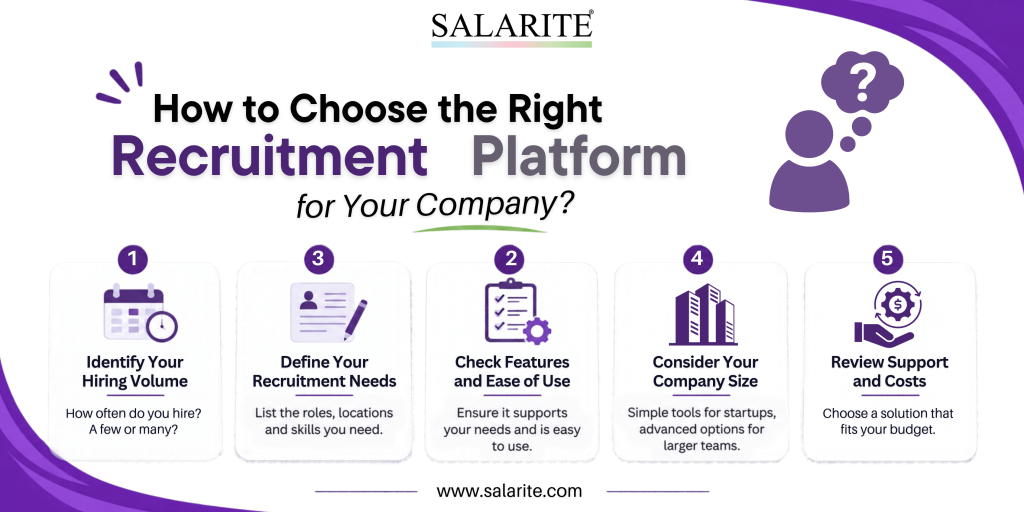
Identify Your Hiring Volume
First, think about how often your company hires. Do you hire a few people each month, or do you need to fill many vacancies at once? Your hiring needs will help you decide which features are important.
Define Your Recruitment Needs
Next, make a list of the roles you need to fill. Include job locations, qualifications, experience, and required skills. This makes it easier to choose a platform that suits your hiring process.
Check Features and Ease of Use
Also, check whether the platform supports the recruitment tasks your team needs. Make sure it is easy to use. In addition, avoid paying for features that do not match your needs.
Consider Your Company Size
Startups and MSMEs may need simple hiring tools at a reasonable cost. On the other hand, larger companies may need more tools to manage applications, several vacancies, and different hiring teams.
Review Support and Costs
Finally, check the platform’s pricing, service terms, and available Virtual Hiring Support. Choose a solution that fits your hiring needs and budget. Also, confirm any extra charges directly with the provider.
Recruitment Platform Needs for Different Industries
Different industries have different hiring needs. For example, a Recruitment Platform for Companies hiring manufacturing workers may need different skills from a bank hiring customer service staff.
How to Hire Manufacturing Employees ?
Companies looking to Hire Manufacturing Employees should first define the job roles and duties.
Depending on the role, candidates may need:
- Technical skills
- Work experience
- Production knowledge
- Quality control skills
- Knowledge of daily work tasks
After that, recruiters can post jobs, review applications, interview candidates, and select suitable people.
A recruitment platform can help organize these steps if it offers the required features.
How to Choose a Finance Recruitment Platform ?
A Finance Recruitment Platform should meet the needs of the roles your company wants to fill. For example, finance jobs may require different qualifications, work experience, and technical skills. Therefore, employers should clearly define these needs before searching for candidates.
Companies hiring across India can also explore a Finance Hiring Platform India to find suitable recruitment options. However, they should check the provider’s location coverage, candidate search options, and available services.
Understanding Banking Recruitment Services
Banking Recruitment Services help companies hire people for banking roles. The hiring process depends on the job title, qualifications, experience, location, and duties. Therefore, employers should check whether the provider understands their needs and can support the required hiring steps.
What to Check in Banking Staffing Solutions ?
When choosing Banking Staffing Solutions, employers should consider:
- Number of vacancies
- Required job profiles
- Candidate qualifications
- Work locations
- Required experience
- Type of hiring support
In addition, check whether the provider offers job posting, candidate sourcing, screening, or other hiring services. Before making a decision, confirm the service details with the provider.
How to Hire Finance Professionals ?
Companies looking to Hire Finance Professionals should first understand the skills and qualifications needed for each role.
A simple hiring process includes:
- Define the job duties.
- List the required qualifications.
- Identify technical and communication skills.
- Find suitable candidates.
- Review applications.
- Interview shortlisted candidates.
- Select candidates based on job needs.
By following these steps, recruiters can compare applicants fairly and make better hiring decisions.
Recruitment Platform Needs for Startups and MSMEs
Startups and MSMEs often have limited time and HR resources. Therefore, choosing the right Recruitment Platform for Companies can help them manage hiring more easily.
Consider these points:
- Limited HR resources: Identify which hiring tasks take the most time.
- Multiple vacancies: Choose a platform that can manage your open jobs.
- Clear job needs: Define the skills and experience required.
- Business growth: Check whether the platform can support future hiring.
- Extra HR support: Consider outside HR services if your business needs them.
Overall, the best platform is not always the one with the most features. Instead, choose one that fits your business and hiring needs.
How Salarite Supports Companies With Hiring ?
Salarite supports recruitment and HR needs for startups, MSMEs, and growing businesses.Its HR services include Recruitment Platform for Companiessupport, training, compliance, onboarding, HR policies, documentation, employee engagement, retention, and employee management.
In addition, Salarite provides Virtual Hiring Support, where a dedicated HR professional works remotely as part of the employer’s team. This gives businesses an option for HR support without needing a full in-house HR team. Therefore, companies should review their hiring needs and decide whether they need recruitment support, extra HR services, or both.
Common Mistakes When Choosing a Recruitment Platform
Employers should avoid these common mistakes:
- Not defining hiring needs: First, know what your company needs before comparing providers.
- Choosing only by popularity: A popular platform may not suit every business.
- Ignoring candidate screening: Check how your team will review applicants.
- Not considering company size: Choose tools that match your hiring needs.
- Assuming all platforms are the same: Always check the features offered by each provider.
- Ignoring industry needs: Different jobs require different skills and qualifications.
- Overlooking the hiring process: Consider every step, from job posting to candidate selection.
By avoiding these mistakes, companies can make a better choice.
Recruitment Platform Selection Checklist
Before choosing a platform, use this simple checklist:
- Define your hiring goals.
- Estimate the number of vacancies.
- Identify job roles and locations.
- Review candidate sourcing options.
- Check screening and application tools.
- Review interview management features.
- Compare platforms for your company size.
- Confirm available features with the provider.
- Check support, service terms, and costs.
- Consider extra HR support if needed.
This checklist can help employers compare platforms and choose a suitable option.
Conclusion: Choose a Recruitment Platform That Fits Your Hiring Needs
Choosing a Recruitment Platform for Companies requires more than comparing product names. Employers should consider company size, hiring volume, candidate sourcing, screening, industry needs, and budget.
For example, businesses hiring manufacturing workers, finance professionals, or banking staff should first understand the skills and qualifications needed for each role. The right platform can help companies organize recruitment tasks and manage hiring more easily. Therefore, choose a solution that meets your current needs and can support your business as it grows.
Your Next Sales Opportunity Could Start With the Right Hire.
Strengthen your channel sales team with candidates aligned with your business goals and recruitment requirements.
Frequently Asked Questions
A Recruitment Platform for Companies is an online tool that helps employers manage job posting, candidate sourcing, applications, screening, and hiring tasks, depending on its features.
Companies should compare hiring volume, Candidate Sourcing Platforms, screening tools, company size, industry needs, support, and costs.
First, companies should define job needs and prepare a job description. Then, they can find candidates, review applications, interview suitable applicants, and select people based on their skills and experience.
A Finance Recruitment Platform helps employers manage hiring for finance-related jobs. However, its features and candidate search options depend on the provider.
Banking Recruitment Services support companies in hiring for banking roles. These services may include candidate sourcing, screening, and other hiring tasks.
Companies should review job needs, hiring volume, location, candidate qualifications, service details, and the provider’s hiring support.
A Finance Hiring Platform India is a hiring solution used to support finance-related recruitment in India. Employers should check its features and location coverage.
Businesses should define the job role, list required skills and qualifications, find candidates, review applications, conduct interviews, and select suitable applicants.
Yes. A recruitment platform may support several hiring tasks. In contrast, an Applicant Tracking System (ATS) mainly helps employers organize applications and track hiring stages. Some platforms offer both types of features.